India's shared AI compute pool crossed 45,000 GPUs this year, and the government has now sanctioned 93.18 lakh subsidised GPU hours to developers across the country. Almost none of that capacity has reached a small business, and the reason has very little to do with price.
The IndiaAI Mission was approved on 7 March 2024 with an outlay of Rs 10,371.92 crore over five years. Its compute pillar is the part that gets quoted most often in MSME conversations, usually as evidence that Indian small enterprises now have access to world-class AI infrastructure at a fraction of commercial rates. The rate card supports that claim. The allocation data does not. This piece works through both, using the numbers the Ministry of Electronics and Information Technology has placed before Parliament rather than the ones that circulate in summary form.
The headline number, and the one underneath it
On 12 August 2026, Minister of State for Electronics and IT Jitin Prasada told the Lok Sabha that the IndiaAI Mission had sanctioned 93.18 lakh GPU hours across 237 projects, and that a purchase order had been issued for a high-performance AI compute system of approximately 1.1 EFLOPS to be installed at the National Informatics Centre data centre in Shastri Park, Delhi. Fifteen compute service providers have been empanelled across four rounds.
Two hundred and thirty-seven projects. That is the number that matters, and it is not a number that gets quoted alongside the 45,000 GPUs.
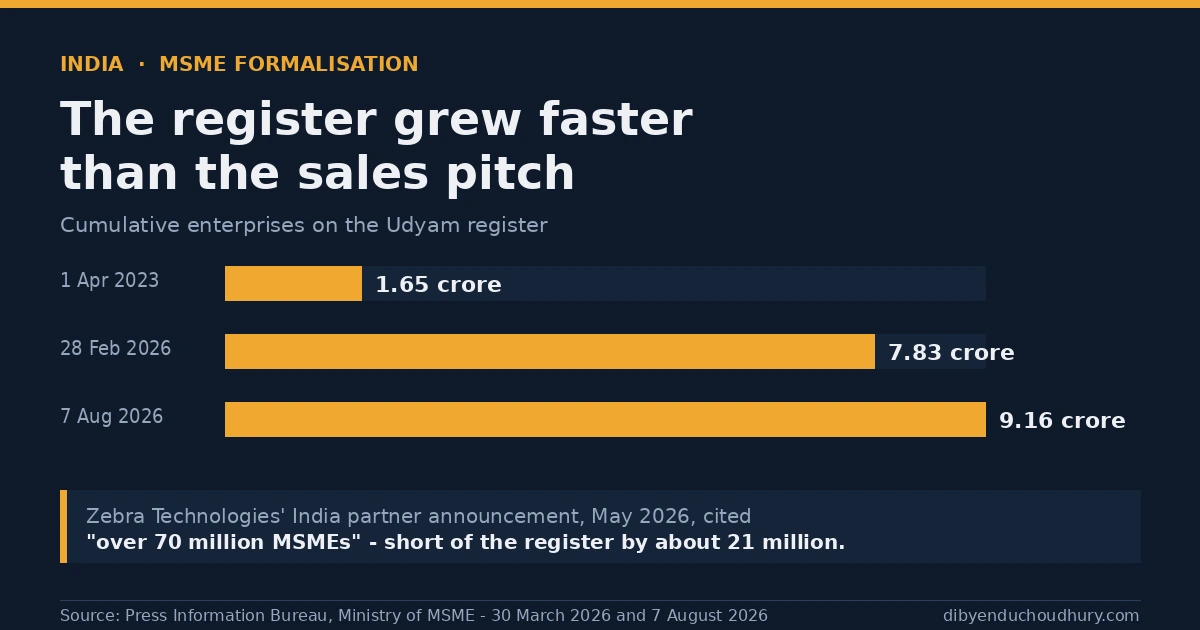
For scale: as of 28 February 2026, 7.83 crore enterprises were registered across the Udyam Registration Portal and the Udyam Assist Platform, according to the Ministry of Micro, Small and Medium Enterprises. If every single one of the 237 sanctioned projects belonged to a registered MSME — and they do not — that would work out to roughly one project for every 33 lakh registered enterprises.
What 93 lakh GPU hours actually represents
The figure sounds enormous until it is placed against the capacity it is drawn from. A pool of 45,000 GPUs running continuously for a year yields roughly 39.4 crore GPU hours. The 93.18 lakh hours sanctioned since the mission began in March 2024 therefore amount to something in the region of 2.4 per cent of a single year's theoretical capacity at current pool size.
That comparison needs two honest caveats. The empanelled capacity is commercial cloud capacity that providers also sell to other customers, so it was never sitting idle waiting for IndiaAI to claim it. And "sanctioned" is not "consumed" — an approved allocation may be drawn down over many months, or not fully drawn at all. But even allowing generously for both, the gap between announced capacity and allocated capacity is wide enough that the compute pool is plainly not the binding constraint on Indian AI development. Demand is.
Divide differently and the picture sharpens further. Spread across 237 projects, 93.18 lakh hours averages roughly 39,300 GPU hours per project. At the subsidised H100 rate of about Rs 92 an hour, that is close to Rs 36 lakh of compute per project. This is a research and model-development budget. It is not a figure that describes a manufacturing unit in Ludhiana trying to automate its invoice matching.
Who the projects actually belong to
The most useful disclosure on this point came earlier. In a reply tabled in the Lok Sabha on 25 March 2026 (PIB Release 2245069), the ministry broke down the 190 projects approved at that stage by applicant type: 78 with government entities, 46 with startups and MSMEs, 30 with early-stage startups, 27 with researchers or academia, five with students and four with early-stage researchers.
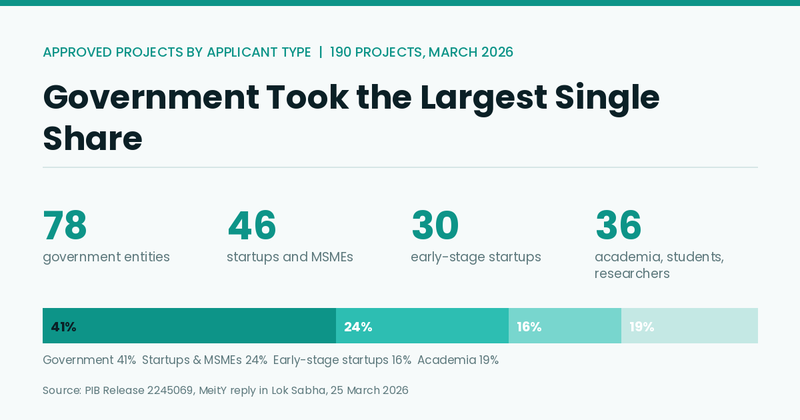
Government entities accounted for 41 per cent of approvals — the single largest block. Startups and MSMEs together took 24 per cent, and that category is reported as one bucket, so the MSME-only share is smaller than 46 and cannot be isolated from the published data. Add the early-stage startup line and the entire private-innovation cohort reaches 40 per cent, still slightly below the state's own share of a scheme whose stated purpose is democratising access.
None of this is scandalous. Government AI projects in health, agriculture and public service delivery are legitimate uses of public compute, and several of them — the I4C CyberGuard work on cybercrime complaint classification, the face authentication deployment at the UPSC — have moved into production. The point is narrower: a programme where the state is the largest single consumer is an industrial-policy instrument, not a small-business access scheme, and it should be described as the first thing rather than the second.
The price is not the barrier
It is worth being precise here, because the affordability story is the one part of the compute pillar that holds up completely.
When the common compute facility was announced, the published rate card put high-end AI compute at around Rs 150 per hour, with a government subsidy of up to 40 per cent bringing the effective cost below Rs 100. Reported subsidised rates for H100-class hardware have since settled in the Rs 65 to Rs 92 range depending on the provider and the subsidy applied, against commercial Indian GPU cloud rates that start well above Rs 200 an hour for the same silicon. A select set of startups building foundation models receive a full subsidy.
Run the arithmetic on a realistic small-enterprise task. Fine-tuning an open 7-billion-parameter model on a domain corpus — a company's own service manuals, say, or a decade of Hindi-language customer complaints — is an eight-GPU job for roughly a day. That is about 192 GPU hours, or under Rs 18,000 at the subsidised rate. A firm turning over Rs 5 crore a year can find Rs 18,000.
So if the compute is cheap and the eligibility criteria explicitly name MSMEs, the shortfall in uptake has to be explained by something else.
The portal is built for people who build models
The IndiaAI Compute Portal's own end-user policy sets out an access path that makes sense for a research group and very little sense for a proprietor. A user registers through Meri Pehchaan using a DigiLocker, Parichay or ePramaan account, completes a registration form, uploads documents establishing which eligibility category they fall into, and waits for a designated verifying official to approve them. Only then can a compute request be submitted, with a resource specification, a draft bill computed from the published rate card, and an optional subsidy request that goes to a committee.
Every step of that is reasonable for public money. Taken together, it describes an institutional procurement process. It presumes the applicant already knows how many GPUs of which class they need, for how many hours, to do what. An MSME that has reached that level of specificity has, almost by definition, already hired someone who could have solved the problem another way.
And that is the deeper mismatch. The overwhelming majority of AI value available to a small Indian business today comes from inference, not training — running an existing model against your own documents, calls, invoices or inventory. Inference is cheap, available on demand from commercial providers by the API call, and requires no allocation, no verifier and no committee. The compute pillar solves a problem that model builders have. Most MSMEs do not have that problem, and telling them that 45,000 GPUs are now available to them describes a door they have no reason to walk through.
What an MSME with a real AI need should actually do
These are drawn from the specific gap this analysis found, not from a general checklist.
Establish whether your problem is a training problem at all. If the answer to "what would the model learn that a general model does not already know?" is vague, it is an inference problem, and the IndiaAI compute route is the wrong instrument regardless of price. Our guide AI for the One-Person Business works through that distinction with worked examples for owner-run firms.
If it genuinely is a training problem, register on the compute portal early and separately from the project. Verification of eligibility documents is a distinct stage from allocation. Completing it before you have a live deadline removes the part of the process you cannot compress later.
Apply through an institutional partner if one is within reach. Twenty-two of the 58 approved AI Centres of Excellence have been initiated across 13 states and union territories, and 27 India Data and AI Labs are operating. A project routed through an academic partner sits in a category with demonstrably higher approval throughput than an unaffiliated small firm.
Cost the subsidy against the delay, not against the commercial rate. The saving on 192 GPU hours is a few thousand rupees. If the approval cycle costs a quarter of commercial momentum, paying full price on a commercial provider is the cheaper decision. The subsidy matters at 39,000 hours, not at 200.
Watch the Shastri Park installation rather than the GPU headline. The 1.1 EFLOPS system ordered for the NIC data centre is state-owned capacity rather than empanelled commercial capacity. How its hours are allocated when it comes online will say more about who this mission is actually for than any further expansion of the empanelled pool.
Where this reading could be wrong
Three things would falsify the argument above, and they are worth stating plainly.
The first is the reporting bucket. "Startups and MSMEs" is published as a single category. If the internal split is heavily weighted towards MSMEs rather than startups, small-enterprise participation is meaningfully higher than the visible data suggests. MeitY has not disaggregated it, and no external source can.
The second is timing. The mission is roughly two and a half years into a five-year term, and the project count moved from 190 in March 2026 to 237 by August 2026 — a 25 per cent increase in under five months. If the private-sector share of that growth is outpacing the government share, the composition problem is correcting itself and this analysis will read as premature.
The third is the possibility of a dedicated MSME window. Nothing in the published material rules out a future allocation stream with its own eligibility route and rate. If MeitY notifies one, the access-design criticism here becomes obsolete rather than merely early.
The thing worth holding onto
The IndiaAI compute pillar is, on the evidence, a competently executed piece of infrastructure policy. Fifteen providers empanelled over four rounds, capacity from 18,417 GPUs to over 45,000 in roughly a year, twenty indigenous foundation models under support including Sarvam's 30B and 105B releases and BharatGen's Param2, 686 fellowships across 178 institutions. Judged as a sovereign-capability programme, it is delivering.
It is being described, however, as something else. The distance between "MSMEs are an eligible category" and "MSMEs are beneficiaries" is the distance between 7.83 crore registered enterprises and a bucket of 46 projects that also contains startups. Both statements can be true at once, and only one of them is useful to a small business owner deciding where to spend a Tuesday.
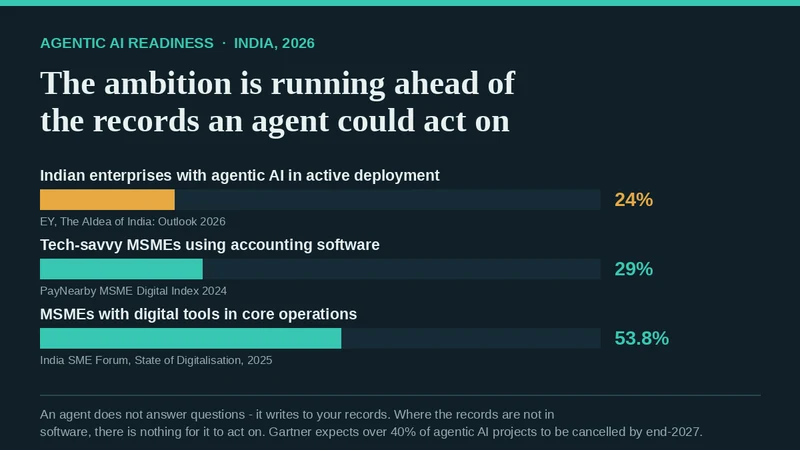
For most Indian MSMEs, the honest answer to "can we actually use IndiaAI's compute?" is: you are permitted to, you probably do not need to, and the cheap GPU hour is not the thing standing between you and an AI capability. Missing data, unstructured records and nobody in-house who owns the problem are the things standing in the way. No amount of subsidised silicon fixes those.
Further reading
- AI for the One-Person Business — an MSME guide to choosing between inference and training, and to the tools that need no allocation at all.
- India's National AI Mission and What It Means for Small Manufacturers
- Indian Firms Spent Big on AI at Scale, Only 12% See Proven ROI: Reading the Gap
Sources
- Ministry of Electronics and Information Technology, reply by MoS Jitin Prasada in the Lok Sabha, 12 August 2026 — 93.18 lakh GPU hours sanctioned across 237 projects; 1.1 EFLOPS system ordered for the NIC data centre, Shastri Park, Delhi; 15 compute service providers empanelled over four rounds; 686 fellowships across 178 institutions; 58 AI Centres of Excellence approved, 22 initiated.
- Press Information Bureau, Release ID 2245069, Ministry of Electronics and IT, 25 March 2026 — IndiaAI Mission outlay of Rs 10,372 crore; more than 38,000 GPUs onboarded; 190 approved projects split by applicant type.
- Press Information Bureau, Release ID 2246892, Ministry of Micro, Small and Medium Enterprises, 28 February 2026 — 7.83 crore enterprises registered across the Udyam Registration Portal and Udyam Assist Platform.
- Press Information Bureau, Release ID 2097709, statement by Union Minister Ashwini Vaishnaw, February 2025 — common compute rate card of approximately Rs 150 per hour with a subsidy of up to 40 per cent.
- IndiaAI Independent Business Division, MeitY, End-User Policy for AI Services on the Cloud — eligibility categories including MSMEs, Meri Pehchaan registration, verifier approval and the subsidy request process.
- IndiaAI / MeitY, Request for Empanelment for AI services on cloud, issued 16 August 2024 — empanelment framework naming academia, MSMEs, startups, the research community and government agencies as eligible users.
- Press Information Bureau, May 2025 — common compute capacity crossing 34,333 GPUs following the addition of 15,916 GPUs to an existing 18,417.