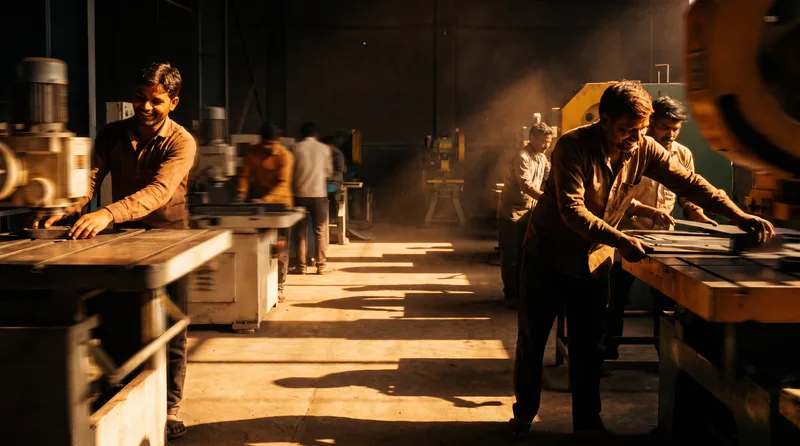
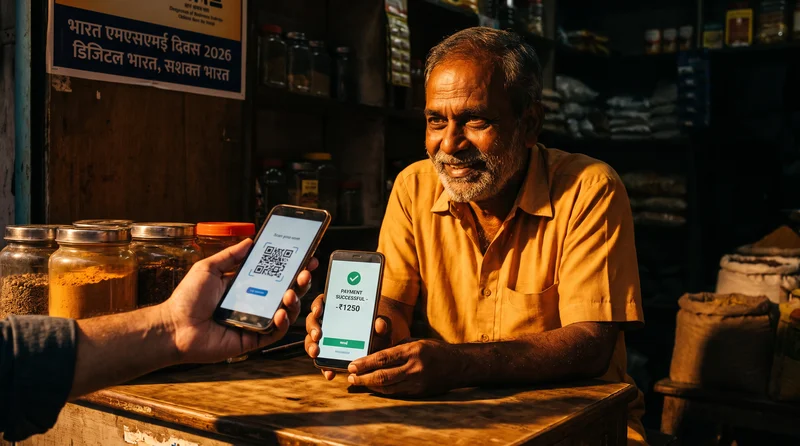
In the calendar year 2025, the number of Indian MSMEs that actually exported anything was 1,73,350. Set that against a sector the Ministry of MSME counts at roughly 7.3 crore enterprises, and the arithmetic is uncomfortable: fewer than one in every four hundred small Indian businesses sells beyond the border. The schemes exist. The doors are open. Almost nobody walks through them.
The Number That Should Bother You
The official story of MSME exports is a genuine success story, and it deserves to be told accurately. In a Lok Sabha reply cited by the Press Information Bureau in 2025, the Union Minister for MSME put the sector at 30.1% of India's GDP, 35.4% of manufacturing output and 45.73% of the country's exports. MSME-linked export value has grown from about ₹3.95 lakh crore in 2021 to roughly ₹12.39 lakh crore in 2025. For the first half of FY 2025-26, April to September, the Ministry reported MSME-related exports of ₹9,52,023.35 crore.
Those are real numbers and they are moving in the right direction. But headline share and participation are two different things, and conflating them is how a structural problem stays invisible. Nearly half of India's export earnings come from the MSME sector, yet that contribution is generated by a vanishingly small slice of the MSME population. The sector is not exporting. A few thousand firms within it are exporting, very well.
"A scheme that 0.2% of its intended beneficiaries use is not a scheme with a funding problem. It is a scheme with a distribution problem."
India vs Germany: The Participation Gap in Numbers
The Observer Research Foundation, in its analysis of India's MSME export data, estimates that only 1% to 2% of Indian MSMEs are active exporters in any meaningful sense. The comparable figure for Germany's Mittelstand is 20% to 25%. That is not a marginal difference in policy performance. It is an order-of-magnitude difference in how a small business relates to the world outside its own country.
| Measure | India | Germany |
|---|---|---|
| Share of MSMEs that actively export | 1–2% | 20–25% |
| Exporting MSMEs, absolute (CY25) | 1,73,350 | — |
| MSME share of national exports | 45.73% | — |
| Typical MSME exporter net margin | 5–12% | — |
Two caveats worth stating plainly, because most write-ups skip them. First, the 1–2% estimate and the 1,73,350 headcount are not measuring quite the same thing — the former is a broader judgement about meaningful export activity, the latter a count of firms recorded as exporting in a single calendar year. Second, India's MSME denominator itself is contested; figures between 7.34 crore and 7.47 crore circulate in official and quasi-official sources depending on whether Udyam Assist registrations are folded in. Either way, the participation ratio stays in the same dismal band.
What the comparison rules out is the comfortable explanation. Indian textiles, processed food, handicrafts and light engineering goods are competitive in global markets on price and quality. The constraint is not that Indian small manufacturers cannot make things the world wants. It is that the machinery connecting them to buyers, to insurance against non-payment, and to working capital priced for a nine-month shipping-and-collection cycle is something most of them have never been walked through.
The Fourteen-Month Hole in the Export Credit Safety Net
Here is the part of the story that rarely makes it into scheme summaries, and it matters more than any brochure.
The Interest Equalisation Scheme — the mechanism that made pre- and post-shipment rupee export credit affordable for small exporters — was discontinued on 31 December 2024. Its replacement, a new interest subvention scheme under the Export Promotion Mission, was launched in early January 2026.
That is a gap of roughly fourteen months in which MSME exporters carried the full commercial cost of export credit, during a period when they were simultaneously being urged to diversify into new markets in response to tariff turbulence. For a business running at a 5–12% net margin, the difference between subsidised and unsubsidised working capital is not a line item. It is frequently the entire margin on the order.
The Cabinet did eventually approve a ₹22,060 crore Export Promotion Mission spanning six years, and the Press Information Bureau announced two specific interventions for MSME exporters under it. But the sequencing tells you something about how export support is actually administered in India: continuity is not guaranteed, and the burden of bridging a policy gap falls on the smallest balance sheets. Any exporter planning a two-year market-entry push should assume the support architecture may change underneath them mid-plan, and price that risk in.
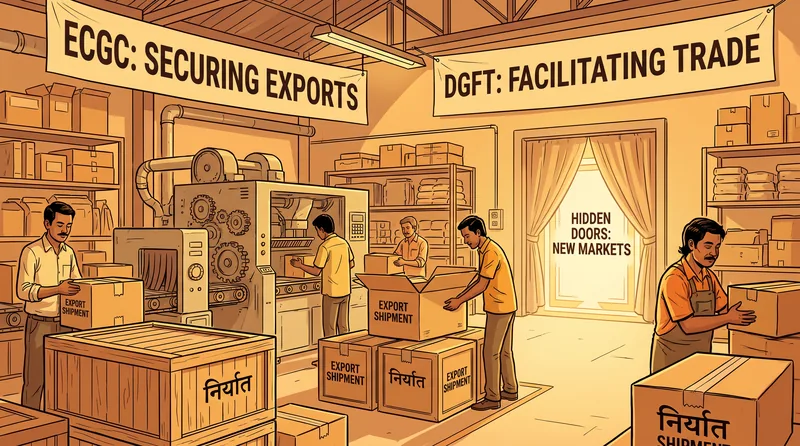
What Actually Sits Behind the ECGC Door
The Export Credit Guarantee Corporation was established in 1957 and is wholly government-owned. The statistic worth knowing about it is this: MSMEs make up roughly 97% of ECGC's client base. It is, in practice, already an MSME institution — just one that most MSMEs have never contacted.
What ECGC sells is protection against the specific risk that kills small exporters: the buyer who accepts the shipment and then does not pay. A domestic default is recoverable through familiar legal channels. A default by an importer in another jurisdiction, against a firm with no local counsel and no appetite for cross-border litigation, is usually a total write-off. For a first-time exporter, one such event ends the export experiment permanently.
Two instruments are worth naming. The Export Credit Insurance Scheme, branded NIRVIK (Niryat Rin Vikas Yojana), raises the cover extended on bank-provided pre-shipment and post-shipment credit, which in turn makes banks materially more willing to lend against export orders — the insurance is as much a credit-access tool as a risk tool. The RELIEF Scheme announced in 2026 went further for a defined window: 100% risk coverage for insured shipments between 14 February and 15 March 2026, tapering to up to 95% for shipments from 16 March to 15 June 2026, with up to 50% reimbursement of additional costs for MSME exporters who had no ECGC cover at all, capped at ₹50 lakh per exporter.
Note the shape of that: the most generous terms were time-boxed to a four-week window. This is a recurring feature of Indian export support and the single strongest argument for maintaining a live relationship with ECGC and your bank's trade desk rather than approaching them only when an order is already on the table. The firms that captured the 100% cover were the ones already inside the system in February.
DGFT, RoDTEP and the Problem With Six-Month Extensions
On the Directorate General of Foreign Trade side, the instrument that matters most to a small exporter's pricing is RoDTEP — Remission of Duties and Taxes on Exported Products. Launched in 2021, it refunds embedded central, state and local levies that are not otherwise creditable, as a percentage of FOB value. The principle is sound: taxes should not be exported. The Union Budget 2025-26 allocated ₹18,232 crore to it, up from ₹16,000 crore in FY25.
The practical problem is not the allocation. It is the tenure. DGFT Notification No. 74/2025-26, dated 31 March 2026, extended RoDTEP for a further six months, from 1 April 2026 to 30 September 2026. Six-month extensions have become the norm rather than the exception.
Consider what that does to a quotation. An exporter negotiating an annual supply contract with a European buyer in August 2026 has to price goods for delivery well past September 2026, without knowing whether the remission that underpins the quoted price will exist at the same rate. The rational responses are all bad: quote conservatively and lose the order, quote optimistically and absorb the loss, or decline to quote annual contracts at all — which is precisely what pushes small exporters into low-value spot transactions and out of the durable buyer relationships that build an export business.
Reading the Fine Print of the 2026 Subvention Scheme
The interest subvention scheme launched in January 2026 is genuinely useful, and it is also narrower than the headline suggests. The published parameters:
- 2.75% base subvention for MSME manufacturer exporters, with additional incentive available for exports to notified under-represented or emerging markets.
- Capped at ₹50 lakh per exporter per financial year.
- Applicable only to exports falling within a notified positive list of tariff lines at the Harmonised System six-digit level, covering approximately 75% of India's tariff lines.
Read the third condition again, because it is the one that determines whether any of this applies to you. Roughly a quarter of India's tariff lines sit outside the positive list. An exporter cannot assume eligibility from sector or MSME status alone — eligibility attaches to the HS six-digit code of the specific product being shipped. Checking your own HS code against the notified list is a ten-minute exercise that determines whether your financing assumptions are real or imaginary, and it is the single most useful thing a would-be exporter reading this can do today.
The ₹50 lakh annual cap also has a distributional consequence worth naming. On a 2.75% subvention, the cap binds at roughly ₹18 crore of subvented credit in a year. For a micro enterprise this is irrelevant — the cap will never bite. For a mid-sized exporter scaling past that threshold, the marginal cost of export credit reverts to commercial rates precisely at the growth stage where volume expansion is being financed. The scheme is, by design, weighted toward keeping small exporters small-but-alive rather than helping them become large.
Where This Architecture Still Falls Short
An honest assessment has to record what this architecture does not do.
It does not address discovery. Insurance and subsidised credit are useful to a firm that already has a buyer. They do nothing for the far larger population of firms that have a shippable product and no idea who abroad might want it. The ORF analysis frames the constraint as one of intelligence rather than capability, and the scheme architecture largely confirms that framing by not attempting to solve it. Nothing in ECGC, RoDTEP or the subvention scheme tells a Tiruppur knitwear unit which mid-sized European importers are currently looking for its product category.
It does not address the compliance threshold. Obtaining an IEC, classifying goods correctly at the HS six-digit level, meeting destination-market standards, and managing documentation are fixed costs that fall entirely on the exporter. These costs do not scale down for a firm with ₹2 crore of turnover, which is a large part of why the participation ratio sits where it does.
And it does not offer tenure certainty. A fourteen-month lapse in interest support, followed by rolling six-month extensions of the principal remission scheme, is not an environment in which a cautious small manufacturer commits capital to a multi-year export plan. If policymakers want the participation ratio to move from 1–2% toward anything resembling the German figure, multi-year certainty is likely to matter more than the headline generosity of any individual scheme.
The counter-argument deserves a hearing: time-boxed and capped schemes are how a fiscally constrained government limits exposure and avoids permanently subsidising uncompetitive firms, and the six-year Export Promotion Mission is itself an attempt to provide exactly the longer horizon that was previously missing. Whether that horizon survives contact with successive budget cycles is the open question, and it is the one worth watching over the next two years.
For an exporter reading this today, the actionable conclusion is narrow and specific: verify your HS six-digit code against the notified positive list before you build any financing assumption on the 2.75% subvention, and open a relationship with ECGC before you need one, because the best terms in 2026 were available only inside four-week windows to firms already on the books.
Sources
- Press Information Bureau, Government of India — "MSME sector accounts for 30.1% of India's GDP, 35.4% of manufacturing and 45.73% of exports", statement of the Union Minister for MSME, 2025 (PIB PRID 2142170).
- Press Information Bureau, Government of India — "Two Key Interventions Launched to Strengthen MSME Exports under Export Promotion Mission" (PIB PRID 2210874).
- Ministry of MSME / DD News — "MSME exports cross ₹9.52 lakh crore in April–September FY26", reporting MSME-related exports of ₹9,52,023.35 crore for H1 FY 2025-26.
- Observer Research Foundation — "Data's First Promise: The Export Conversations India's MSMEs Have Always Needed", on the 1–2% versus 20–25% India–Germany export participation gap and the CY25 count of 1,73,350 exporting MSMEs.
- Directorate General of Foreign Trade — Notification No. 74/2025-26 dated 31 March 2026, extending the RoDTEP Scheme from 1 April 2026 to 30 September 2026.
- Union Budget 2025-26 — RoDTEP allocation of ₹18,232 crore, against ₹16,000 crore in FY25.
- Cabinet Committee decision — Export Promotion Mission, ₹22,060 crore over six years, incorporating the successor to the Interest Equalisation Scheme (discontinued 31 December 2024); new interest subvention scheme launched January 2026 at 2.75% base rate, capped at ₹50 lakh per exporter per financial year, restricted to a notified HS six-digit positive list covering approximately 75% of tariff lines.
- Export Credit Guarantee Corporation of India — NIRVIK / Export Credit Insurance Scheme; RELIEF Scheme 2026 coverage terms (100% cover 14 Feb–15 Mar 2026; up to 95% for 16 Mar–15 Jun 2026; up to 50% cost reimbursement for uninsured MSME exporters, capped at ₹50 lakh). ECGC established 1957; MSMEs constitute approximately 97% of its client base.
- SIDBI — "Understanding Indian MSME Sector: Progress and Challenges", May 2025.