Almost everyone who grows up in India knows the picture: a woman dragged into a hall, a man pulling at her sari, and a length of cloth that never ends. It is the image that gets painted, filmed and staged. It is also the part of the episode that the most rigorous scholarly edition of the Mahabharata does not contain — and its absence changes what the scene is actually about.
Strip out the miracle and what remains in the Sabha Parva is not a rescue. It is a legal argument, made by a woman who had every reason to plead and chose instead to cross-examine. She asked one question. Nobody in the hall could answer it. That failure, not the cloth, is what sets the rest of the epic in motion.
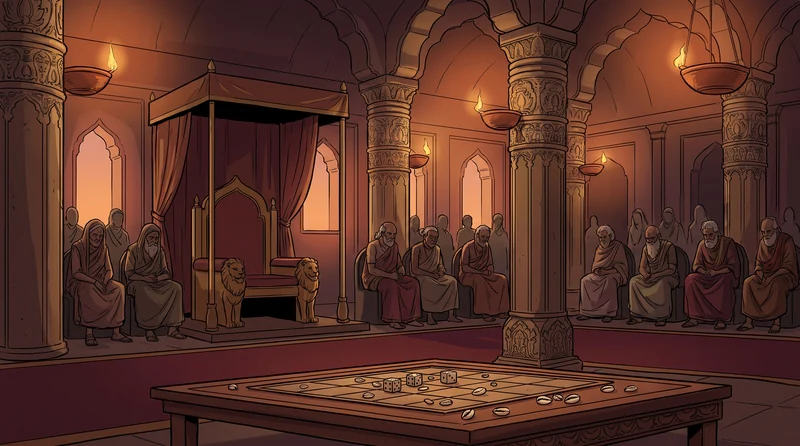
The Twentieth Throw: What Was Staked, and In What Order
The dice game occupies the Dyuta Parva section of the Sabha Parva, the second of the epic's eighteen books. Yudhishthira does not lose everything at once. He loses in a sequence, and the sequence is the whole point.
He stakes and loses movable wealth first — jewels, gold, chariots, cattle. Then the treasury, the army, the territory, the city itself. Then, when there is no property left, he begins staking people: Nakula, then Sahadeva, then Arjuna and Bhima. Then he stakes his own person and loses that too. Only after he has ceased to be a free man does he stake Draupadi, in the last of the twenty throws.
Order matters in law the way it does not matter in drama. A retelling can compress this into "he gambled away his kingdom and his wife." The text refuses to compress it, and Draupadi's entire case rests on the refusal.
The Question, Stated Precisely
Draupadi is not in the hall when the game ends. She is in her chambers, menstruating and in a single garment, when a messenger arrives to tell her she has been won and must present herself as a servant.
She does not go. She sends the messenger back with a question, and the question is addressed not to the winners but to the loser: ask the gambler in that assembly whom he lost first — himself, or me?
The claim is not that the wager was cruel. The claim is that it was void. A man who has already forfeited his own legal personality has nothing left with which to transact.
This is a jurisdictional objection, not an appeal to sympathy. If Yudhishthira was already property at the moment he staked her, then he was not a competent party to the contract, the stake was a nullity, and the Kauravas hold nothing. Draupadi is asking the assembly to rule on the validity of a transaction — which requires them to first decide a prior question they would very much rather not touch: whether a wife was ever her husband's to stake at all.
Vikarna's Three Grounds
One person in that hall attempts an actual legal answer, and he is not one of the elders. Vikarna, a younger Kaurava brother, rises and argues that Draupadi has not been lawfully won. He offers three grounds:
- She is the common wife of all five Pandavas, not Yudhishthira's alone — so no single husband had unilateral authority to stake her.
- Yudhishthira had already lost himself before offering her, and therefore staked what he had no standing to offer.
- The stake was not freely proposed but prompted by Shakuni, the opposing party — an obvious defect in a wager.
The hall reportedly erupts in approval. And then nothing happens. Vikarna is shouted down by Karna, the argument is not taken up by anyone with the authority to conclude it, and the assembly moves on. India's oldest recorded dissenting opinion is delivered by a junior figure, applauded, and ignored — a pattern anyone who has sat in an institutional meeting will recognise instantly.
"Dharma Is Subtle": How an Assembly Avoided a Ruling
Draupadi presses the elders directly, and the answer comes from Bhishma — the most senior man present, the one whose word could have ended it. He tells her that the course of dharma is subtle, that even the wise fail to grasp it, and that he cannot say whether she has been won or not.
It is worth being blunt about what that sentence is. It is not humility. It is a presiding authority declining jurisdiction in a matter he is fully competent to decide, because deciding it would require him to rule against the household that feeds him. The epic knows this. Bhishma spends the rest of the Mahabharata paying for that afternoon, and dies on a bed of arrows still explaining dharma to people.
The sabha in this scene is not a mob. It is a functioning constitutional body — a hall of kings, elders, a chancellor in Vidura, a chief justice in all but name in Bhishma — that receives a well-framed legal question and produces no ruling. The epic is not depicting the absence of institutions. It is depicting institutions that exist, are staffed by capable people, and fail anyway.
What the Critical Edition Removed
Between 1919 and 1966, the Bhandarkar Oriental Research Institute in Pune undertook one of the largest textual-critical projects ever attempted in any language. Under the initial direction of V. S. Sukthankar, scholars collated over 1,200 manuscripts of the Mahabharata from across the subcontinent and beyond, in a dozen scripts, to reconstruct the earliest recoverable text. The Critical Edition was completed in 1966.
Two episodes that most Indians assume are load-bearing turn out not to be in it. One is Ganesha serving as Vyasa's scribe. The other is the divine miracle in which Krishna extends Draupadi's sari without end. Both are later additions, present in some manuscript traditions and absent from the reconstructed archetype.
This is not a debunking, and it does not make the devotional version illegitimate — a tradition is entitled to grow. But it does change the literary architecture of the scene. In the popular version, the question is a prelude and the miracle is the climax: heaven intervenes, the problem is solved, the audience exhales. In the reconstructed text there is no exhale. There is a woman making an argument, an assembly that cannot answer it, and an unresolved dissonance that the epic deliberately leaves standing.
The Same Question, Litigated Again: England 1882, India 2020
Draupadi's question — can a woman be the subject of a transaction rather than a party to it? — is not an ancient curiosity. Legal systems have taken an extraordinarily long time to answer it, and the timeline is unflattering to everyone.
| System | Position on a wife's legal personality | When it changed |
|---|---|---|
| Kuru sabha, Sabha Parva | Question raised, formally never answered | Never adjudicated in the text |
| English common law (coverture) | Blackstone: the wife's legal existence is "suspended during the marriage" and consolidated into the husband's; she could not own, contract or sue in her own name | Married Women's Property Acts, 1870 and 1882 |
| Hindu succession law, India | Daughters excluded from coparcenary rights in joint family property | Hindu Succession (Amendment) Act, 2005; settled by the Supreme Court in 2020 |
The Indian entry deserves detail, because it shows how recent this is. Section 6 of the Hindu Succession Act was amended in 2005 to make daughters coparceners by birth. Courts then spent fifteen years disagreeing about who it applied to — in particular, whether a daughter's claim survived if her father had died before the amendment took effect on 9 September 2005. In Vineeta Sharma v. Rakesh Sharma, decided on 11 August 2020, a three-judge bench of the Supreme Court speaking through Justice Arun Mishra held that coparcenary status is a birthright, that the father need not have been alive on that date, and that the daughter's right does not depend on the accident of when a man died.
Put the two dates side by side. The English question of whether a married woman is a legal person took until 1882. The Indian question of whether a daughter is a full owner by birth took until 2020 to be conclusively settled. Draupadi asked a version of it in a hall that could not answer, and the honest position is that no legal system answered it quickly.
The Uncomfortable Part: She Never Got Her Answer
Retellings tend to end this scene triumphantly, and it is worth resisting that. Draupadi does not win her argument. What actually happens is that Dhritarashtra, unnerved by ill omens and by the collapse of order in his own hall, offers her boons. She uses them to free Yudhishthira and then her other husbands, declines a third, and the Pandavas walk out with their liberty restored.
That is an act of executive clemency, not a judgment. The king exercises discretion; the question of whether the stake was valid is never ruled on. Draupadi leaves the hall free and unanswered — which is precisely why the grievance does not dissolve. A pardon extinguishes a penalty. It does not settle a point of law, and it does not undo a humiliation that a competent authority declined to name as wrongful. Thirteen years of exile and eighteen days of war follow from a question the system would not process.
There is a further discomfort worth naming. Draupadi's own case is framed within the property logic she is contesting: her strongest argument is not "I cannot be staked," it is "I cannot be staked by him, at that moment." Vikarna's first ground has the same shape. The scene is not a modern feminist manifesto and reading it as one flattens it. It is something more interesting: a text that puts a devastating question into the mouth of a character who cannot yet fully articulate its widest form, and then declines to resolve it.
Why an Unanswered Question Outlives a Settled One
Indian courts have reached for this scene when confronted with the same silence. In 2018, hearing a case concerning a woman paraded semi-naked in a Tarn Taran village, a judge of the Punjab and Haryana High Court invoked the Kuru assembly explicitly — not the villain, but the bystanders, and what their silence eventually cost. That is the reading the text supports. The scene's enduring subject is not Duryodhana's malice, which needs no explanation. It is Bhishma's non-answer, Drona's silence, and the applause for Vikarna that produced no consequence.
If you want to read the episode properly rather than remember it, three things are worth doing. Read the Sabha Parva sequence in a full translation — Bibek Debroy's unabridged English rendering of the Critical Edition is the accessible standard — and note how much of it is procedural argument rather than spectacle. Watch what happens to the pace when the miracle is not there to release the tension. And notice who speaks, who applauds, and who rules, because the epic is counting all three separately.
The dice game is often described as the moment the Mahabharata turns towards war. That is true but incomplete. It turns because a hall full of qualified people were asked a clear question and decided that not answering was safer. Everything that follows is the cost of that afternoon.
Sources
• Mahabharata, Sabha Parva (Book 2), Dyuta Parva section — sequence of stakes, Draupadi's question, Vikarna's objection, Bhishma's reply.
• Bhandarkar Oriental Research Institute, Pune — Critical Edition of the Mahabharata, project initiated 1919 under V. S. Sukthankar, completed 1966; the divine re-robing episode and the Ganesha-as-scribe episode are not part of the reconstructed text.
• Bibek Debroy, The Mahabharata (unabridged English translation of the Critical Edition), Penguin India.
• William Blackstone, Commentaries on the Laws of England (1765–1769) — the doctrine of coverture.
• Married Women's Property Act 1870 and Married Women's Property Act 1882, Parliament of the United Kingdom.
• Hindu Succession (Amendment) Act, 2005 (India), amending Section 6 of the Hindu Succession Act, 1956.
• Vineeta Sharma v. Rakesh Sharma & Ors., Supreme Court of India, judgment dated 11 August 2020, (2020) 9 SCC 1 — three-judge bench, per Justice Arun Mishra.
• The Tribune, report on Punjab and Haryana High Court observations drawing a parallel with the Sabha Parva episode, 2018.
📬 Join 49,000+ Indian Professionals
The Inner Circle newsletter delivers curated MSME intelligence, leadership wisdom, and strategic insights every week — completely free. Plus receive the 20 Gita Lessons PDF as a welcome gift.
Subscribe Free →Ready to Go Further?
My mythology and fiction titles bring these stories alive for the modern reader. Available on Amazon India.
Explore My Books on AmazonPublished 14 August 2026 · dibyenduchoudhury.com