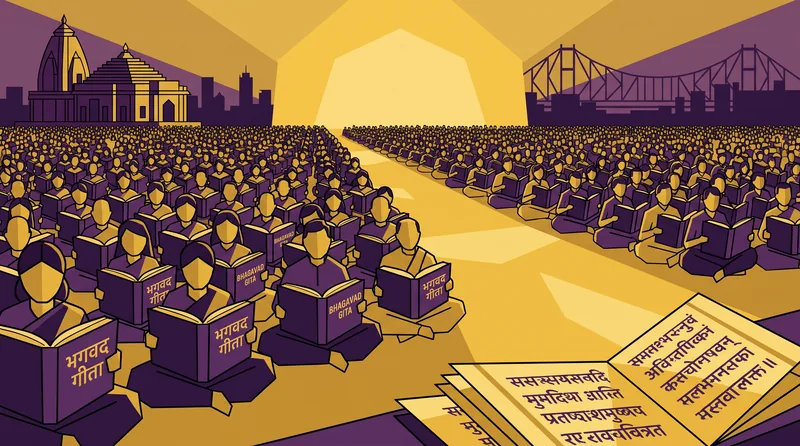
The Bhagavad-gītā contains eighteen chapters and 700 verses. After all of it — after the teaching on the soul, the teaching on action and inaction, the teaching on knowledge and devotion and renunciation — Kṛṣṇa gives one final instruction. He calls it the most confidential of all, the cream of all teaching. It is three lines: Abandon all dharmas and surrender to Me alone. I will deliver you from all sin. Do not fear. If you understand nothing else from the Bhagavad-gītā, understand this.
The Final Instruction of the Bhagavad-gītā
The verse is among the most debated in all of Indian philosophy. What does it mean to abandon all dharmas? Does it mean abandon ethics? Abandon duty to family and society? Become a renunciant? Prabhupāda’s answer was clear. It does not mean abandon duty. Kṛṣṇa has just spent seventeen chapters instructing Arjuna to perform his duty — he would not reverse this in the last verse. What ‘abandon all dharmas’ means is: abandon the idea that any dharma of yours — any duty, any virtue, any practice, any achievement — can save you on its own. Abandon the self-reliance that makes you think you can reach liberation through your own effort, your own goodness, your own merit. Surrender that self-sufficiency to Kṛṣṇa. Let Him be your refuge, not your ego.
sarva-dharmān parityajya mām ekaṃ śaraṇaṃ vraja ahaṃ tvāṃ sarva-pāpebhyo mokṣayiṣyāmi mā śucanḥ
— Bhagavad-gītā 18.66
Translation: Abandon all varieties of religion and just surrender unto Me. I shall deliver you from all sinful reactions. Do not fear.
Purport: Three sentences. Three complete teachings. First: the action required — surrender to Kṛṣṇa alone. Second: the result guaranteed — liberation from all karma, all consequence, all sin. Third: the response this calls for — fearlessness. Prabhupāda said this verse is not an invitation. It is a command from the Supreme Lord and simultaneously the most generous offer ever made to a human being. Kṛṣṇa does not say ‘try to surrender’ or ‘surrender when you are ready.’ He says: surrender, and I will take responsibility for everything else.
What ‘Abandon All Dharmas’ Actually Means
The question Prabhupāda was often asked: what does surrender look like in practice? It does not require leaving one’s home or job or family. It requires a shift of identity at the deepest level: from ‘I am the master of my situation’ to ‘I am Kṛṣṇa’s servant.’ This shift, once made genuinely, changes the entire texture of a life. The surrendered soul still acts, still plans, still takes responsibility. But the motivation is different. The anxiety is different. The relationship with outcome is different. A person who has truly surrendered to Kṛṣṇa is not passive. They are the most active, the most engaged, the most fully present people in any room — because they are free from the self-protective calculations that paralyse those who have not surrendered. They have nothing to protect. Kṛṣṇa is protecting it. The Vaiṣṇava tradition did not leave this vague. Sanātana Gosvāmī records in the Hari-bhakti-vilāsa the six limbs of śaraṇāgati, and Śrī Caitanya Mahāprabhu repeats them to Sanātana in the Caitanya-caritāmṛta: to accept what is favourable for devotional service, to reject what is unfavourable, to be convinced that Kṛṣṇa will give protection, to accept Him as one’s maintainer, to give oneself fully to Him, and to be humble. Read that list slowly and notice what is absent from it. There is no requirement of renunciation, no requirement of scholarship, no requirement of ritual competence, no requirement of birth or wealth or position. Every limb is an internal movement, available to a clerk in an office and to a sannyāsī in equal measure. Prabhupāda made this point relentlessly when students asked whether they were qualified: the qualification for surrender is the willingness to surrender, and nothing else. He also warned against the counterfeit — the person who declares surrender in words while keeping the decisive matters of his life firmly in his own hands. Surrender that has not yet touched what you are most afraid to lose has not yet begun.
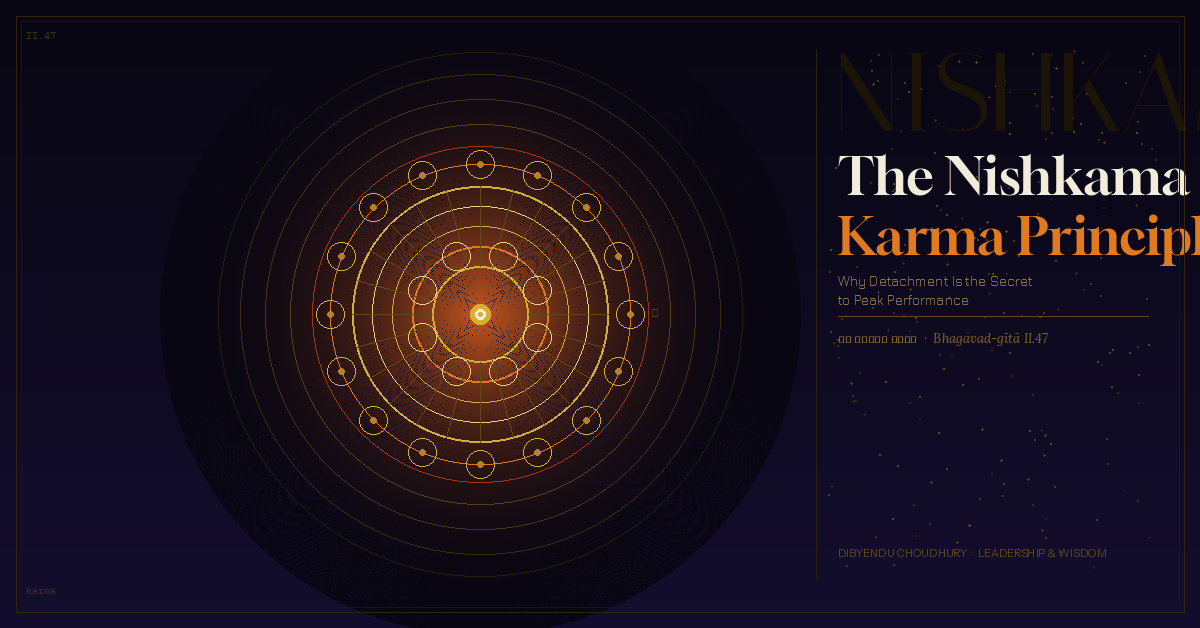
“Surrender is not the giving up of everything. It is the giving up of the one thing that makes everything else heavy: the belief that you are ultimately responsible for saving yourself.”
Why Surrender Is Strength, Not Weakness
The modern world worships self-sufficiency. To surrender — to anyone, for any reason — is read as weakness, dependency, failure of character. This is precisely the inversion of understanding that māyā produces. In the Vedic understanding, surrender to the Supreme is the supreme act of intelligence. It is the recognition of what is actually true: that I am a minute ātmā, dependent on Kṛṣṇa for my very existence, for the energy with which I breathe and think, and that my attempt to live as though I am self-sufficient is a kind of cosmic pretence. When I surrender, I am not giving up power. I am releasing the exhausting pretence of a power I do not actually have. Prabhupāda called this the position of full knowledge. It is also the position of rest. The soul that has surrendered to Kṛṣṇa is the most free soul in existence.
ananyāś cintayanto māṃ ye janāḥ paryupāsate teṣāṃ nityābhiyuktānāṃ yoga-kṣemaṃ vahāmy aham
— Bhagavad-gītā 9.22
Translation: But those who always worship Me with exclusive devotion, meditating on My transcendental form — to them I carry what they lack, and I preserve what they have.
Purport: Surrender activates this verse. When you surrender to Kṛṣṇa, He personally takes responsibility for your yoga-kṣema — your welfare, your protection, your spiritual progress. This is not theology. It is the consistent experience of the genuine devotee across thousands of years of the Vaiṣṇava tradition. Kṛṣṇa does not abandon those who have come to Him. Mā śucanḥ is not encouragement. It is a fact.
The Promise: Mā Śucanḥ — Do Not Fear
If you have read the Bhagavad-gītā before and found it beautiful but not yet acted on it, this verse is the invitation being extended again. If you have never read it, this verse is where to begin. The entire Bhagavad-gītā is Kṛṣṇa’s extended explanation of why this surrender is both reasonable and necessary, and the paths through which it can be approached. When you have understood those paths, this final verse is where you arrive: one soul, one Lord, one surrender, one promise. The daily practice of this surrender is bhakti — the offering of each action, each meal, each chant, each moment to Kṛṣṇa. It is simple. It is profound. It is the only solution the Bhagavad-gītā offers to the complete problem of material existence. And Kṛṣṇa guarantees it.
Sarva-dharmān parityajya mām ekaṃ śaraṇaṃ vraja. Abandon all varieties of religion and just surrender unto Me. This is not a suggestion from a philosopher. It is the word of the Supreme Person, spoken with complete authority, backed by complete power, and offered with complete compassion. He says: do not fear. He means it. Your only task is to take Him at His word.