There is a particular silence that arrives on the second Monday. The first Monday after a long institutional role ends still feels like leave. The second one does not. The phone that rang forty times a day rings twice, and both calls are from banks. I have watched this happen to colleagues at NI-MSME and, before that, at two business schools, and I went through my own version of it when my faculty role with the Ministry ended in March 2025. What surprised me was not the change in income. It was the absence of a script.
India is about to run this experience at a scale no society has attempted before. The UNFPA India Ageing Report puts the decadal growth rate of the elderly population at 41 per cent and projects that Indians aged sixty and above will more than double to over 20 per cent of the population by 2050. By 2046, on the same projections, there will be more elderly Indians than children under fifteen. The eighty-plus cohort alone is expected to grow by roughly 279 per cent between 2022 and 2050. Whatever we do or fail to do about the years after work is not a private matter. It is about to become one of the defining social questions of the republic.
The arithmetic nobody disputes
The financial half of this problem is at least being argued about, and the numbers are not flattering. The Mercer CFA Institute Global Pension Index for 2025 places India forty-fifth out of forty-seven systems assessed, holding a D grade with an overall score of 43.8, marginally down from 44.0 the previous year. The adequacy sub-index, which measures whether the system actually delivers a liveable income, carries an E. Taken together, the Employees' Provident Fund Organisation, the National Pension System and the Atal Pension Yojana cover under a quarter of the working population, one of the lowest inclusion rates recorded anywhere.
The consequences are visible in the same UNFPA data. More than 40 per cent of India's elderly fall in the poorest wealth quintile, and about 18.7 per cent live with no income at all. The Economic Survey for 2025-26 acknowledged the expansion the NPS has achieved while conceding that coverage remains structurally limited by the sheer informality of Indian employment. None of this is contested. The policy conversation, correctly, is about widening the net.
But widening the net answers only the question of subsistence. It does not touch the question that a very large number of adequately pensioned Indians will spend the next twenty years failing to answer.
The question the numbers cannot reach
Consider the officer who retires from a Grade A post with a defined-benefit pension, a house that is paid for and children who are earning well. By every measure in the pension index, this person has been well served. Speak to him eighteen months later and you will frequently find something that looks a great deal like grief, and which he will not name as such because he has no vocabulary for it and no permission to use it.
The reason is not mysterious. Indian professional life, and government service in particular, is a total institution in the sociological sense. The designation is not what you do; it is who you are understood to be, by your family, your neighbours, your bank manager and yourself. Notice how Indians introduce one another at a wedding. The name comes second. What comes first is the post, and if the post has ended, the word we reach for is retired, which is the only stage of Indian life in ordinary public vocabulary that is defined entirely by subtraction. We describe a student by what he is acquiring and a householder by what he is sustaining. We describe the third stage of life by what has been taken away.
This was not always so, and the tradition that most of these same men would call their own had a considerably more intelligent answer.
What vanaprastha actually prescribed
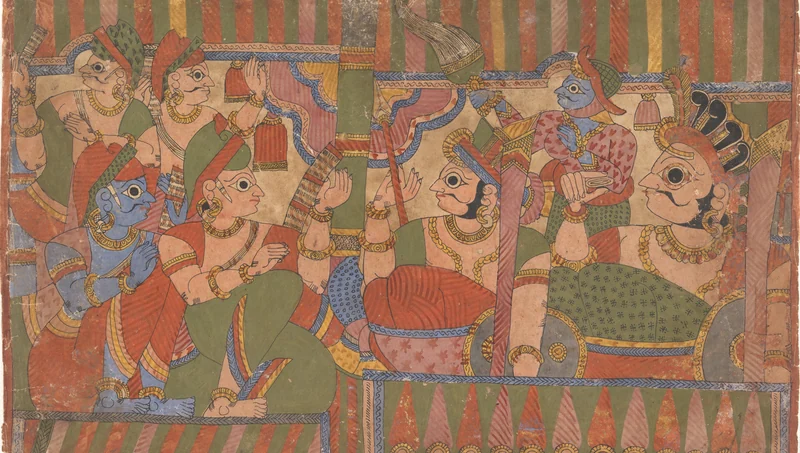
The classical Indian life-scheme divided the span of a life into four ashramas: brahmacharya, the period of learning; grihastha, the householder years of earning, raising and sustaining; vanaprastha, conventionally rendered as the forest-dweller stage; and sannyasa, renunciation. The scheme is usually invoked today as a piece of decorative heritage, and the third stage in particular is usually mistranslated.
Vanaprastha is habitually read as withdrawal, as though the prescription were to disappear. Read the actual injunctions and what you find is not cessation but a transfer of function. The householder hands over the management of the estate and the running of the household to the next generation. He does not vanish from the family; he ceases to command it. His obligation shifts from accumulation to transmission. He becomes available as counsel and unavailable as authority. For some this involved a literal move to the forest edge; for most it was a graduated reduction of entanglement conducted in place, with the texts describing a stepwise relinquishing of property, of ritual obligations, of the appetite for social position.
The decisive point is not the forest. It is that the third stage had a name, a set of duties and a recognised social standing of its own. It was a station, not a vacancy. A man entering it was understood to be doing something, and the something he was doing was held in higher regard than what he had been doing before. That is what a script is, and that is precisely what has gone missing.
What replaced it
What replaced it was superannuation, an administrative category imported with the colonial civil service and retained without modification. Superannuation is a date. It generates a pension, a farewell function, a shawl and a memento, and it makes no claim whatsoever about what the following twenty-five years are for. The Indian middle class has kept the retirement date with great fidelity and quietly discarded the ashrama that used to give it meaning. We have inherited the arithmetic and lost the anthropology.
The result is three failure modes that anyone who has spent time in Indian institutions will recognise on sight. One man refuses to leave. He pursues an extension, then a consultancy, then an advisory chair, not for the money but because the alternative is unthinkable to him. A second leaves and folds inward, his world contracting to the newspaper, the television and a shrinking circle of relatives, his health following his world down. The third is the most socially rewarded of them. He treats the years after work as a second householder stage and monetises thirty years of relationships at speed, which serves him well enough until the network ages out and he finds he has built nothing that will outlast him.
What a modern vanaprastha would ask of us
Three propositions, then, offered as practical rather than sentimental.
Change the organising verb. Not accumulation but transmission. Mentorship, examinership, institution-building, board and trustee work, teaching, writing, the patient construction of things that will be used by people you will never meet. The test is not whether it pays. The test is whether the output outlives you. This is neither charity nor hobby; it is the specific work that only a person carrying forty years of pattern recognition can do at all, and Indian institutions are chronically short of it.
Reduce entanglement on purpose, and early. The classical instruction was to hand over the estate before circumstances forced the handover, and the wisdom in it is the wisdom of choosing while you still have the standing to choose. Decide what you will stop doing. Say so publicly. A relinquishment that is announced is a decision; one that is discovered is a defeat.
Then the hardest of the three, and the genius of the original scheme: availability without authority. The vanaprastha stands ready to counsel and waits to be asked. He does not summon, does not overrule, and does not treat the household of the next generation as an annexe of his own. Anyone who has watched a retired institutional head keep his grip on the place from outside knows exactly how much structural humility this asks for. And exactly what it costs the institution when it is missing.
The gap our institutions could close tomorrow
There is a straightforward policy point buried here. Government departments and large corporates run elaborate pre-retirement counselling on provident fund settlement, commutation, CGHS enrolment and tax on the commuted portion. I have sat through several of these sessions. Not one of them gave five minutes to role transition, which is the thing that will actually determine how the next two decades go. A half-day module on what the third stage is for would cost a department almost nothing and would alter the trajectory of a great many capable people.
Universities could do more than award emeritus titles as honorifics and could attach real teaching and supervisory function to them. Industry associations and MSME bodies could formally absorb retired officials as standing advisors, which would simultaneously solve a hand-holding problem that small enterprises complain about constantly and give experienced administrators something worth their time. None of this requires legislation. It requires only that we stop treating the years after work as a residue.
The mistake I made first
My own error, in the early months, was to treat the gap as a vacancy that had to be filled quickly, and to fill it with activity. Activity is not the same as function, and the difference took me a while to feel. I wrote about a related version of this problem in Pause. Reflect. Live: What the Gita Knew About the Interrupted Mind, and the same principle applies with more force here. A mind that has never been given a reason to be still will not become still merely because the appointments have stopped.
The tradition never promised that the third stage would be comfortable. What it offered was something more durable than comfort. It said that this part of a life has its own work, that the work is more consequential than what preceded it, and that a man in it is not a man who has finished. Twenty per cent of India will be living in that stage within a generation. We can arrive there with a pension and no idea what it is for, or we can go back and read what we already knew.