You know the morning when the body simply refuses. The eyes open, the ceiling is there, and nothing in you moves toward the day. Your hands are unsteady. The work sits waiting and you cannot lift it. Then a second suffering arrives on top of the first: the suspicion that you have invented all of this, that a stronger person would simply stand up, that what you are calling collapse is only self-indulgence dressed in a serious word. That second suffering is often heavier than the first. So let me tell you plainly where the Bhagavad-gītā begins. Not in a temple, not in meditation, but on a battlefield, in the body of a man who has just discovered that his hands will not hold his weapon. Before Kṛṣṇa speaks one word of instruction, Arjuna is permitted to describe, at length and without interruption, what is happening to him.
Arjuna's Breakdown: The Bhagavad-gita's First Diagnosis of Depression
Read the first chapter of the Gītā slowly and you will notice something most readers hurry past. Arjuna does not begin with theology. He begins with symptoms. He does not say, I have doubts about the ethics of this war. He says, look at what is happening to my body. The greatest archer of his age, the man who won Draupadī with an impossible shot, stands between two armies and reports the failure of his own nervous system as calmly as a physician writing notes on a patient he happens to inhabit. Śrīla Vyāsadeva could have compressed all of this. He could have given us one line of sorrow and moved briskly on to the philosophy. He does not. He gives Arjuna the space of many verses, and in those verses the description stays physical, particular and unsparing. This is deliberate. Scripture is never careless with its words. When Kṛṣṇa-dvaipāyana Vyāsa spends verse after verse on trembling limbs, on a dry mouth, on a mind that is wheeling, he is establishing the thing the rest of the book depends upon: the despair was real, it was located in a body, and it was witnessed by God in full before it was corrected by God. Hear how Arjuna himself puts it in Bhagavad-gītā 1.29.
vepathuś ca śarīre me roma-harṣaś ca jāyate gāṇḍīvaṁ sraṁsate hastāt tvak caiva paridahyate
— Bhagavad-gītā 1.29
Translation: My whole body is trembling, my hair is standing on end, my bow Gāṇḍīva is slipping from my hand, and my skin is burning.
Purport: Notice what Arjuna reports and what he does not. He does not report a mood. He reports gooseflesh, burning skin, a mouth gone dry, and Gāṇḍīva, the bow given to him by the demigods, sliding out of a grip that has never once failed in battle. In Bhagavad-gītā 1.30 he adds that his mind is reeling and that he cannot keep standing. This is the language of a body under grief, and the Gītā sets it down without embarrassment and without apology. Nowhere does Vyāsadeva instruct Arjuna to compose himself before addressing the Lord. Understand this well. If your suffering has taken up residence in your hands, your sleep and your appetite, you are not thereby disqualified from the spiritual platform. You are sitting precisely where the Gītā's first student was sitting when the instruction began.
Trembling Limbs, Burning Skin, a Bow That Slips
Now the objection arrives, and it is a fair one. If chapter one records the collapse so honestly, why does chapter two open with what sounds like a rebuke? Kṛṣṇa does not soothe. He does not tell Arjuna that his feelings are valid and then leave him sitting in the chariot. He calls the condition impotence, petty weakness of heart, and He tells him to stand. To an ear trained on gentler counsel this sounds severe, and I will not soften it, because the severity is not the point. The sequence is the point. Kṛṣṇa listens through the whole of chapter one. He hears the trembling described, the bow named, the dry mouth admitted, the reeling mind confessed. Only after Arjuna has been allowed to finish, and only after Arjuna himself says in Bhagavad-gītā 2.7 that his very nature is overcome by weakness and asks to be instructed as a surrendered disciple, does the medicine come. A physician who prescribes before he examines is a fraud. Kṛṣṇa examines first. And observe further that He never once denies that the symptoms exist. He denies that the symptoms are the final word about who Arjuna is. That single distinction carries the entire second chapter. Hear the instruction as Kṛṣṇa gives it in Bhagavad-gītā 2.3.

“Kṛṣṇa never tells Arjuna that the trembling was imaginary. He tells him that the trembling is not the whole truth of who he is. To be asked to rise is not to be told that you never fell.”
Why Krishna Calls It Weakness of Heart, Not Weakness of Character
Take this into your own hours. First, say plainly what is happening, to Kṛṣṇa and to at least one human being who will not flinch. Arjuna did not manage his despair privately. He spoke it aloud to the Supreme Person sitting an arm's length away, and that speaking was the first movement of the cure. Second, if the body is genuinely disordered, if sleep and appetite and thought have broken down over weeks, then go to a competent physician as you would for a fever, and stay under treatment. There is nothing whatsoever in the Gītā that forbids it. Kṛṣṇa Himself instructs in Bhagavad-gītā 6.16 and 6.17 that yoga is impossible for one who eats too much or eats too little, who sleeps too much or sleeps too little, and that regulation in eating, sleeping, working and recreation is the very ground on which practice stands. A teaching that legislates about your sleeping hours is not a teaching that despises your body. What I place before you here is the soul's dimension of the matter, which no tablet reaches and which no honest physician claims to treat. Third, do not wait to feel well before you serve. Kṛṣṇa's instruction in Bhagavad-gītā 2.47 is that you have a right to prescribed work and never to its results. Chant, cook, sweep the floor, read one verse aloud. Good feeling is not the price of admission.
klaibyaṁ mā sma gamaḥ pārtha naitat tvayy upapadyate kṣudraṁ hṛdaya-daurbalyaṁ tyaktvottiṣṭha paran-tapa
— Bhagavad-gītā 2.3
Translation: O son of Pṛthā, do not yield to this degrading impotence. It does not become you. Give up such petty weakness of heart and arise, O chastiser of the enemy.
Purport: The word Kṛṣṇa uses is hṛdaya-daurbalyam, weakness of the heart, and it is not a verdict on Arjuna's character. In the same breath He addresses him as Parantapa, chastiser of the enemy. He names the man by his strength while naming the condition by its name, and that is how a genuine well-wisher speaks. Weakness of heart in the Gītā's usage means the heart's forgetfulness of its own constitutional position as eternal servant of Kṛṣṇa, and Kṛṣṇa begins treating that forgetfulness at once in Bhagavad-gītā 2.12 and 2.13, teaching what the self actually is and what it is not. He does not say the trembling was theatre. He says the trembling is not the truth about you. Arise, He says, and the arising is possible only because the falling was first spoken aloud.
Rising Without Pretending the Pain Was Never There
Now the deepest matter, and I will not decorate it. Without Arjuna's collapse there is no Bhagavad-gītā at all. Sañjaya describes him in Bhagavad-gītā 1.28 as overwhelmed with compassion and speaking in a voice choked with sorrow, and it is out of that sorrow that every verse of the remaining seventeen chapters proceeds. Had Arjuna felt perfectly well that morning, he would have fought a war, won a kingdom, and left us no book. The breakdown is not an interruption of the revelation. It is the opening of it. This is not a consoling sentiment, it is a structural fact of the text. Queen Kuntī understood it and prayed for it openly in Śrīmad-Bhāgavatam 1.8.25, asking that calamities come again and again, because in calamity there is the meeting with Kṛṣṇa that prosperity conceals. And Kṛṣṇa says something in Śrīmad-Bhāgavatam 10.88.8 that deserves careful reading by anyone whose life has been stripped bare: when He feels special mercy toward someone, He gradually takes away that person's wealth. I am not telling you your suffering was posted to you as a reward, and I am not asking you to be grateful for it. I am telling you what Arjuna discovered on that chariot. The ground gave way, and underneath the ground there was a Person.
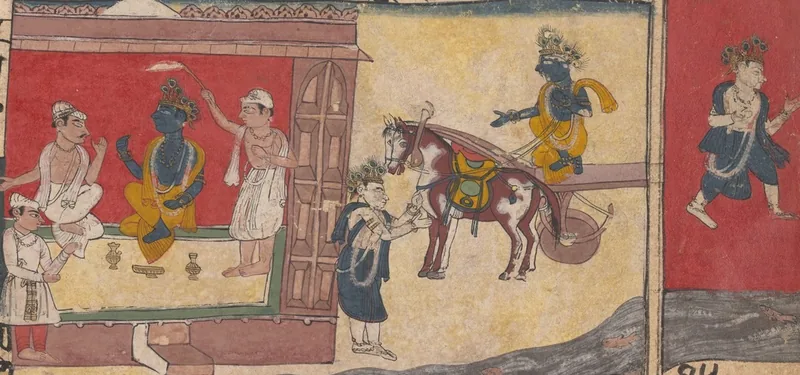
So do not clean yourself up first. That is the last instruction I have for you and it is the most important one. Arjuna threw down his bow, sat back on the chariot seat, and declared in Bhagavad-gītā 2.9 that he would not fight, and Kṛṣṇa did not leave the chariot. He stayed. He listened. Then He spoke. Take shelter in exactly that way. Speak to Him in whatever condition this day has left you in, with the honest sentence and not the pious one. Then chant His holy names, Hare Kṛṣṇa Hare Kṛṣṇa, Kṛṣṇa Kṛṣṇa Hare Hare, Hare Rāma Hare Rāma, Rāma Rāma Hare Hare, in a voice that shakes, for five minutes, with no feeling in it at all. He promises in Bhagavad-gītā 18.66 to deliver the one who surrenders to Him. He attaches no condition about how you must feel while doing it.
From the Book
This article draws on the Depression chapter of Bhagavad Gita for Everyday Life, my forthcoming book applying Kṛṣṇa’s instruction to the specific afflictions of ordinary life. The chapter treats every verse the Gītā assigns to depression, verse by verse, with the word-by-word meaning and its application to work and family.
Go deeper now: The Steady Sage.