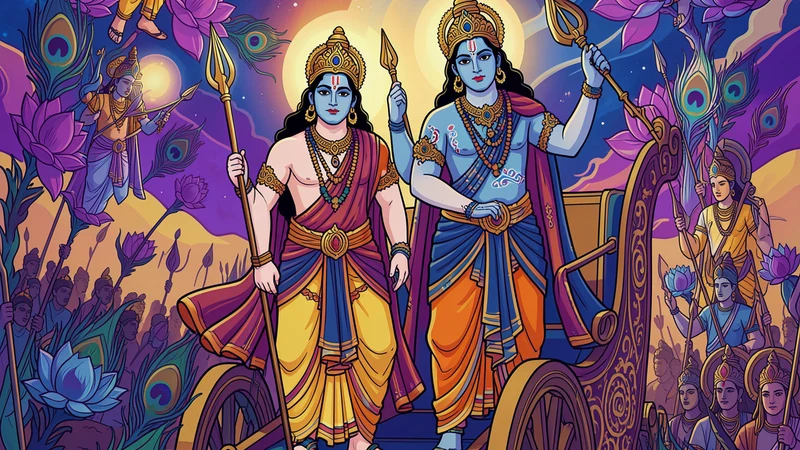
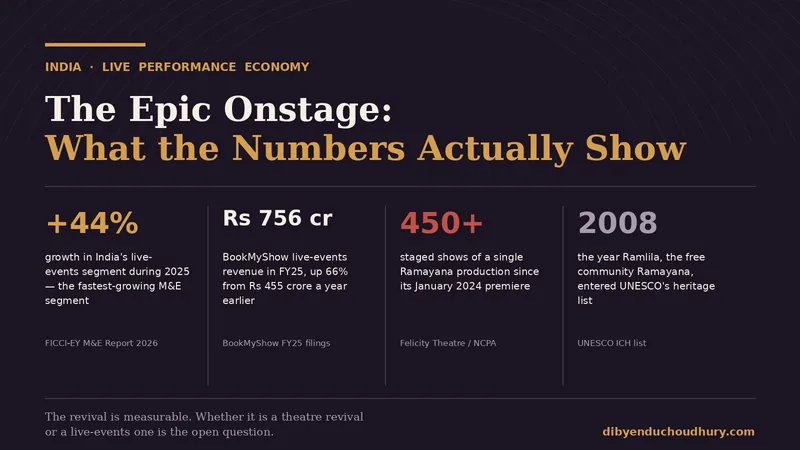
A Hindi play about Rama has been staged more than 450 times since January 2024. That is not a figure the Indian theatre industry has produced in living memory for a single production, and it is the number that anyone arguing about a stage revival has to start from. Humare Ram, produced by Rahul Bhuchar under the Felicity Theatre banner and directed by Gaurav Bhardwaj, opened with seven shows at Delhi's Kamani Auditorium between 25 and 28 January 2024. It has since played the Jamshed Bhabha Theatre at the NCPA, the Nita Mukesh Ambani Cultural Centre in Mumbai, Dubai Opera in August 2025, and is booked into the Eventim Apollo in London from 9 to 12 July 2026.
The temptation is to read that as theatre coming back. The numbers underneath tell a more interesting and more uncomfortable story, and it is worth separating what is actually growing from what we would like to believe is growing.
What the 450-show number does and does not prove
Run the arithmetic. Roughly 450 shows across about 30 months is fifteen performances a month, spread across at least six cities and two countries. That is a touring model, not a residency. Broadway and the West End work on eight shows a week in one house; a long-running West End title clears 400 performances inside a year at a single address. Humare Ram took two and a half years and a national tour to reach a comparable count.
This is not a criticism of the production. It is a description of the market it operates in. India has no theatrical infrastructure that permits an open-ended sit-down run, so the only way to accumulate audience is to move. Outlook India reported on 1 May 2024 that the Mumbai leg closed with eight housefull shows at the Jamshed Bhabha Theatre — eight, and then the set came down and travelled. Demand was not the constraint. Available dates were.
So the honest reading of 450 is this: it proves sustained audience appetite for the epic staged at scale. It does not prove that Indian theatre has found a repeatable economic model, because the production had to solve the same venue problem 450 separate times.
The growth is real. Most of it is not theatre.
The FICCI-EY Media & Entertainment Report 2026, released on 24 March 2026, found that live events expanded 44 per cent during 2025, making them the fastest-growing segment of an industry that reached ₹2.78 trillion overall. Digital crossed ₹1,00,000 crore; advertising remained the largest single revenue pool at ₹1,50,000 crore. Live events, at roughly ₹14,500 crore, is a small segment growing quickly rather than a large one.
Read the composition and the picture sharpens further. The report attributes that 44 per cent to concerts, celebrity-led performances, weddings, government programmes and religious gatherings. Weddings. Government programmes. These are enormous line items, and a Ramayana staged at the NCPA sits somewhere in the remainder after they are subtracted.
BookMyShow's own FY25 numbers make the same point from the other direction. Live-events revenue reached ₹756 crore, up 66 per cent from ₹455 crore; online ticketing contributed ₹828 crore; total income was ₹1,869 crore and net profit ₹192 crore, against ₹109 crore the previous year. KKR announced an investment in the platform on 18 August 2026. Capital is arriving in Indian live entertainment. It is arriving because of arena-scale music, not because of proscenium drama.
Which means epic theatre is currently riding a wave it did not create and does not control. That is a genuinely useful position — cheap discovery, a warm ticket-buying public, promoters willing to take a call — and a fragile one.
Two economies wearing the same story
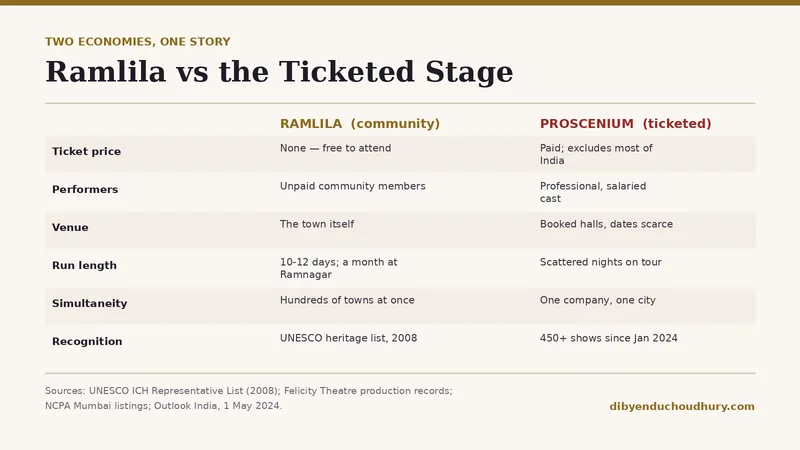
The Ramayana has been performed continuously in India for centuries, and its dominant form costs the audience nothing. Ramlila, inscribed on UNESCO's Representative List of the Intangible Cultural Heritage of Humanity in 2008, is staged across northern India each autumn during Dussehra, built on Tulsidas's sixteenth-century Ramcharitmanas. Most cycles run ten to twelve days. The Ramnagar Ramlila at Varanasi runs for a month.
Its economics are the inverse of the ticketed model in every respect. Performers are largely unpaid community members. The venue is the town itself. Costume, mask-making and effigy work are contributed labour. Funding comes from local patrons and temple committees. There is no gate, no promoter margin, no touring cost, and no scarcity of dates.
Set the two side by side and the contrast is stark. Ramlila reaches an audience of tens of thousands per town, at effectively zero ticket price, with no ceiling on how many towns can run one simultaneously. The proscenium production reaches perhaps a thousand a night, at ticket prices that exclude most of the country, with a hard ceiling set by auditorium availability. One is culturally universal and commercially invisible. The other is commercially legible and culturally narrow.
Calling the second a revival of the first is a category error. What has actually happened is that a story with unlimited free supply has acquired a paid premium tier — and the interesting question is who is buying it, and why they would.
The Adipurush inversion
The most instructive comparison is not between stage and Ramlila but between stage and screen, in the same year, on the same epic. India Today ran the contrast on 10 November 2024 under a headline that put it plainly: a Ramayana play became a superhit while a big-budget film bombed.
The film in question had vastly more capital, distribution across thousands of screens, and a marketing budget the theatre production could not approach. It failed on treatment — dialogue and design that audiences read as disrespectful to material they hold as sacred. The play, working with a fraction of the money, gave Ravana a hearing, kept the register formal, and used LED backdrops and choreographed set-pieces as support rather than spectacle-for-its-own-sake.
The lesson producers took from this is not "stage beats screen." It is that with sacred material, the audience is auditing reverence before it audits production value, and it audits harshly. That is an unusual market condition. It rewards restraint, which is cheap, over scale, which is not — and it is the single clearest reason a theatre company could beat a studio on the same story.
The diaspora is quietly underwriting the second life
Look at where these productions actually go. Dubai Opera in August 2025. Eventim Apollo, London, in July 2026. And on the Mahabharata side, the most ambitious staging of the past decade was not made in India at all.
Why Not Theatre's Mahabharata, written and adapted by Ravi Jain and Miriam Fernandes and drawing on Carole Satyamurti's verse retelling, premiered at Canada's Shaw Festival in March 2023 in association with the Barbican, then played London and Sydney. It runs about five hours across two parts, Karma and Dharma, with a cast drawn from the South Asian diaspora — the first major international production of the epic mounted by a South Asian-led company.
This matters commercially, not just symbolically. Diaspora markets deliver higher ticket yields in hard currency, venues with real technical capacity, and booking calendars that function. A four-night Hammersmith run can be worth more than a month of Indian dates. The risk is equally clear: a form whose growth economics depend on audiences abroad will, over time, be shaped by what those audiences want. India's own epic theatre may end up partly commissioned by Toronto, London and Dubai.
Readers who want the decision-making inside the Mahabharata rather than its staging will find it worked through in Leadership Lessons from the Mahabharata: Ten Decisions That Decide Everything, which treats ten turning points in the epic as choices under uncertainty rather than as plot.
The venue arithmetic that caps all of it
Everything above runs into one constraint. At the India International Music Week discussion reported by Music Ally on 13 February 2026, the recurring theme was that India has a venues problem: too few plug-and-play halls and arenas, multi-agency clearances that slow planning in smaller cities, and organisers booking dates up to two years ahead. Mumbai still lacks a purpose-built modern arena and repurposes sports stadiums instead.
For a concert promoter this is an irritation. For a theatre producer it is existential, because theatre needs the same house for consecutive weeks to amortise a set. When the calendar only yields scattered weekends, the production must be built to strike and travel — which raises unit cost, caps run length, and makes the sit-down economics that sustain Broadway and the West End impossible before a single ticket is sold.
There has been movement. The Nita Mukesh Ambani Cultural Centre, opened in Mumbai in 2023, now hosts international touring musicals. But one world-class house in a country of 1.4 billion is not an ecosystem. The FICCI-EY report projects live events spreading into more than 20 cities in the coming years; whether those cities acquire halls that can take a technically demanding show is a separate question that no report currently answers.
Where the two market estimates disagree — and why it matters
One caution for anyone quoting figures on this. The FICCI-EY Report 2026 puts the live-events segment at roughly ₹14,500 crore for 2025 and includes weddings, government events and large religious gatherings. A BookMyShow–EY-Parthenon study circulated the same year sizes India's live-events market at about ₹13,000 crore, covering concerts, festivals, comedy tours and cultural experiences.
Those are close numbers describing different things. The gap between them is where ticketed cultural performance actually lives, and neither study breaks out theatre separately. So the honest position is that nobody currently publishes a credible figure for what Indian theatre earns. Anyone citing a precise rupee number for the stage sector is extrapolating, and should say so.
What would prove this reading wrong
Three things would settle it, and all are observable within about eighteen months.
First, a sit-down run: any production holding one Indian house for six or more consecutive weeks would show the venue constraint is loosening. Second, a second and third hit that are not Ramayana or Mahabharata — if the epic is the draw rather than the form, the revival is myth-specific and does not generalise to theatre. Third, an original commission that begins abroad but is authored and rehearsed in India, which would indicate the diaspora is funding Indian work rather than importing it.
Until at least one of those appears, the accurate description is narrower than the headlines: a small number of unusually well-executed epic productions have found real audiences by touring hard, exploiting a live-events boom they did not start, and reaching diaspora markets with better venues and stronger currencies. That is a genuine achievement. It is not yet a sector.
The older form, meanwhile, will run again this autumn in a few hundred towns, for free, as it has for four centuries. Whatever the ticketed stage eventually becomes, it is competing with an incumbent that has never needed a box office.
Sources
FICCI-EY, Media & Entertainment Report 2026, released 24 March 2026 (live events +44% in 2025; sector at ₹2.78 trillion; digital above ₹1,00,000 crore; advertising ₹1,50,000 crore; projected expansion into 20+ cities).
BookMyShow FY25 financial disclosures (live-events revenue ₹756 crore, up from ₹455 crore; ticketing ₹828 crore; total income ₹1,869 crore; net profit ₹192 crore).
BookMyShow–EY-Parthenon live-events market study (India live events ≈ ₹13,000 crore).
KKR, investment in BookMyShow announced 18 August 2026.
Felicity Theatre production records for Humare Ram; Kamani Auditorium premiere 25–28 January 2024; NCPA Mumbai listings; Dubai Opera 14–17 August 2025; Eventim Apollo London 9–12 July 2026.
Outlook India, 1 May 2024 — Mumbai run concluded with eight housefull shows at the Jamshed Bhabha Theatre, NCPA.
India Today, Ashutosh Acharya, 10 November 2024 — comparison of the stage Ramayana's success against the underperforming big-budget film adaptation.
Why Not Theatre, Mahabharata (Ravi Jain and Miriam Fernandes, after Carole Satyamurti); Shaw Festival premiere March 2023 in association with the Barbican, London; subsequent London and Sydney seasons.
UNESCO Representative List of the Intangible Cultural Heritage of Humanity — Ramlila, the traditional performance of the Ramayana, inscribed 2008.
Music Ally, 13 February 2026 — India International Music Week report on venue shortages and two-year booking lead times.
The Indian Express (Sunday Eye), 19 April 2026 — survey of epic stage productions in India.
Further reading
E-book: Leadership Lessons from the Mahabharata: Ten Decisions That Decide Everything — 16 pages on the epic's ten pivotal decisions, read as leadership under uncertainty.
Blog: Draupadi's Question at the Dice Game: The Moment That Changed Everything
Blog: Indian Cinema's Mythology Turn: What the Mahabharata and Ramayana Revival Says About the Market
Blog: Karna and the Lesson of the Greatest Warrior